

Key differences between the interim remedy regimes in the UK, the Netherlands and in arbitration
On 13 November 2026, the Netherlands Commercial Court organised a seminar titled: Interim Remedies – Commonalities and Differences in Common Law and Civil Law- You are leaving Rechtspraak.nl. About 50 persons attended the seminar in the courtroom, and 95 joined online from Asia, the Middle East, Africa, the US and Europe.
Interim remedies in the UK, the Netherlands and in arbitration
The keynote speech was given by Mr Justice Henshaw (Judge in Charge of the London Commercial Court) who explained the various interim remedies available under English law. Next, Professors Xandra Kramer and Gerard Meijer (Erasmus School of Law) did the same for Dutch law and arbitration.
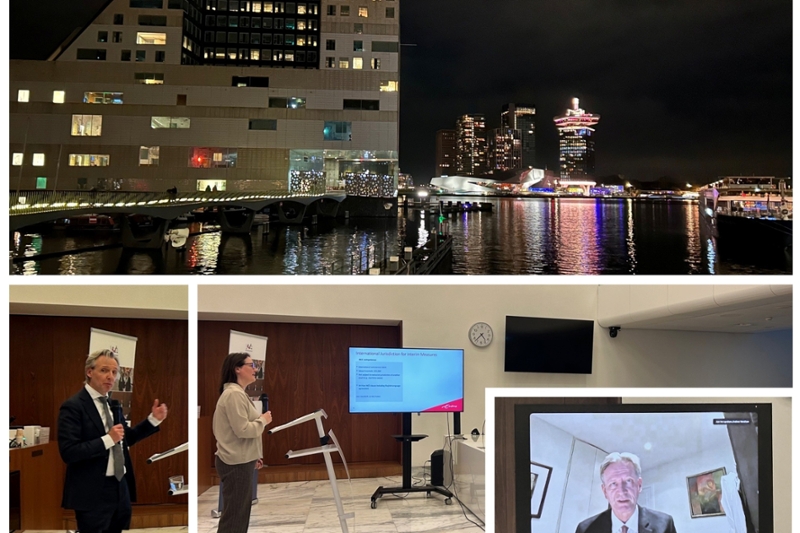
From left to right: Professor Meijer, Professor Kramer and Justice Henshaw
Their powerpoints may be accessed below:
- Interim remedies under English law- You are leaving Rechtspraak.nl
- Interim remedies under Dutch law- You are leaving Rechtspraak.nl
- Interim remedies in arbitration- You are leaving Rechtspraak.nl.
The full seminar is available for replay here: https://media.rechtspraak.nl/MediaSite/Play/f1b21d88cd4141cdb80252e85ea8fd761d- You are leaving Rechtspraak.nl
The interactive session, led by Judge Duco Oranje (President of the NCC Court of Appeal), showed that there are some key differences between the various interim remedy regimes.
Relationship between interim measures and main proceedings
Under English law main proceedings, if not already commenced, must be initiated immediately, which in practice means within 24 hours after the interim measure has been granted; the applicant has to ‘undertake’ to the court that this will be done, and non-observance results in a party being in contempt of court.
Under Dutch law only freezing orders (conservatoir beslag) need to be followed by initiation of the main proceedings. Summary proceedings (kort geding; Art. 254 et seq. Dutch Code of Civil Procedure- You are leaving Rechtspraak.nl) are stand-alone proceedings which only cease to have effect where main proceedings are initiated which result in a different outcome (which rarely happens).
The same applies under the Dutch Arbitration Act, but it depends on the rules of the arbitration institute whether main arbitration proceedings need to be made pending following an application for emergency arbitration. It is a requirement under the ICC Rules- You are leaving Rechtspraak.nl (non-observance results in the emergency arbitration being terminated; Art. 1(8) of Appendix IV). The Rules of the Netherlands Arbitration Institute- You are leaving Rechtspraak.nl do not require main arbitration proceedings to be pending or made pending (Art. C.3(2) of the NAI Rules).
Anti-suit and anti-arbitration injunctions
Anti-suit injunctions are very common in the English court (on average once or more a month over the last three years); anti-arbitration injunctions are less common.
In the Netherlands anti-suit injunctions are less common, as such injunctions are not allowed between EU courts (CJEU C-159/02 (Turner) and C-185/07 (West Tankers)). Anti-suit injunctions are allowed in regard to litigation in non-EU courts, but this does not happen often (for example Ericsson vs Apple- You are leaving Rechtspraak.nl).
Also anti-arbitration injunctions are rare in the Netherlands, but recently some courts of appeal granted them in cases concerning bilaterial investment treaties. A Supreme Court appeal against one of the decisions is pending (LC Corp B.V. vs Republic of Poland; see the opinion of the Advocate-General- You are leaving Rechtspraak.nl).
Enforcement of interim remedies abroad
Interim remedies granted by a Dutch court are enforceable within the EU and the EEA, provided the judgment is served on the defendant prior to enforcement (Art. 2(a) Regulation No. 1215/2012 and Art. 32 Lugano Convention). The Hague Conventions on enforcement of judgments do not allow for enforcement of interim remedies (Art. 4(1) of the 2005 Choice of Court Convention and Article 7 of the 2019 Judgments Convention).
Post-Brexit the enforcement abroad of interim measures granted by UK courts has become unusual. However, a worldwide freezing injunction can have effect overseas as it restrains a respondent in its actions worldwide.
Whether a decision given by an emergency arbitrator is enforceable inter alia depends on the form of the decision: whether it is an ‘award’ (enforceable under the New York Convention) or an ‘order’ (in principle, unenforceable, but the substance of the decision may also be taken into account; substance over form approach). Under the ICC Rules, the emergency arbitrator’s decision is an order (Art. 6 of Appendix IV); under the NAI Rules, it is an award (Art. C.8).